An Absolutely Extraordinary God
The opening lines of Les Murray’s extraordinary poem, “An Absolutely Ordinary Rainbow” herald an entirely new event The word goes round Repins, the murmur goes round Lorenzinis, at Tattersalls, men look up from their sheets of numbers, the Stock Exchange scribblers forget the chalk in their hands…
The opening lines of Les Murray’s extraordinary poem, “An Absolutely Ordinary Rainbow” herald an entirely new event
The word goes round Repins,
the murmur goes round Lorenzinis,
at Tattersalls, men look up from their sheets of numbers,
the Stock Exchange scribblers forget the chalk in their hands
and men with bread in their pockets leave the Greek Club:
There’s a fellow crying in Martin Place. They can’t stop him.
There is chaos at the heart of the city, as crowds respond to this man behaving as people are not expected to behave. The weeping one touches many with his public tears and people’s lives – even for a moment – are transformed.
We encounter a range of reactions; silence and peace, confrontation and fear. And some receive, we are told, “the gift of weeping”.
Only the smallest children
and such as look at out of Paradise come near him
and sit at his feet, with dogs and dusty pigeons.
We hear echoes of Jesus encountering crowds, who bustle and bless and bluster as he moves amongst them. Children are prevented by disciples and gathered by Jesus, rich men navigate their path and wander away confused, unnamed women and men find all their answers, while the powerful find questions they are unwilling to unravel.
and many weep for sheer acceptance, and more
refuse to weep for fear of all acceptance…
This blind beggar, crying out in the crowd, sees nothing and everything, as Jesus walks by. Some seek to prevent him, but like the tiny children, Jesus welcomes him. And this man with almost nothing leaves everything to come to Jesus and life.
How often, and too easily, we let the flow of the crowd around us moderate, or prevent, our response to those in need. How automatically I let convenience dictate what I will say and do with my discipleship. When the voices cry out, can we listen, or are there too many things to do?
The confrontation of suffering appears too muc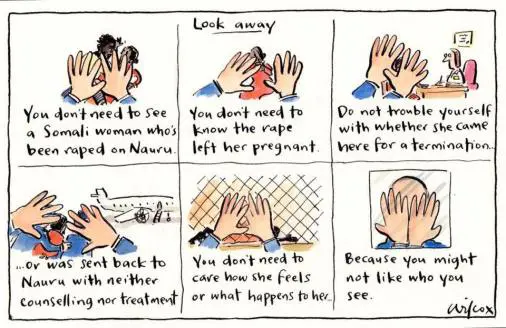 h for us, and we shy away, seeking comfort that others will act, or that prayer is our best answer. Prayer is always an answer, but more often than we hope or expect, there is more. Perhaps we are called to weep publicly for those who suffer, or to speak because they have been silenced by poverty, or injustice, or simple exhaustion.
Cathy Wilcox’s demanding cartoon in the Herald on Monday this week “Look Away” articulates the fractures in our leadership, our community and our discipleship.
Bartimaeus’ hope in Jesus is realised in healing and life – and we might well have prevented him. The grace which first welcomed us now reminds and urges us to listen for those who weep, for those who mourn, for those who rejoice and to be with them, as in the encounter we will all encounter Jesus.