Poles Together
In the last few weeks I have a had a couple of similar, interesting conversations about the “social justice” element of discipleship, as opposed to the “evangelistic” element of following Jesus. One of the frustrating patterns of discussion is when people only want to understand a point of view when…
In the last few weeks I have a had a couple of similar, interesting conversations about the “social justice” element of discipleship, as opposed to the “evangelistic” element of following Jesus.
One of the frustrating patterns of discussion is when people only want to understand a point of view when it is exclusive … “You can’t believe both this and that, you can only have one or the other.” We know, of course, that this is clearly untrue; you can like both opera and cinema, you can enjoy both country and western music (or so I’m told). However, people of all positions – politicians, preachers and pundits – use the argument that you can’t hold both ends of an argument.
People who have self-tagged themselves as evangelical Christians often talk about social justice as if it is an aberration of true discipleship. Our task is to bear witness to Jesus Christ, and to bring people to faith. So when Jesus tells all who are listening to be “dressed for action” it is about our proclaiming the Gospel to anyone we can.
Advocates of social justice, on the other hand, will argue that our actions speak louder than words, and that how we echo the reign of God in the world is far more articulate than any sermon. When Jesus says “Sell your possessions and give alms”, it’s clear that we need to live the Gospel and not rely on our words.
The problem with both these arguments, and with this theology, is that Jesus almost never makes that distinction. You’ll find that Jesus talks about being dressed for action immediately after selling our possessions [cf. Luke 12.32-40].
I am engaged in advocacy for those in need because I believe how I bear witness to my faith in the crucified and risen Jesus is by feeding the hungry, asking why they are hungry, and sharing my experience of a God who feeds all those who hunger for bread and new life.
Isaiah lambasted people’s worship, telling them their hands were covered in blood. “Pray all you like,” says God through Isaiah, “I won’t hear you.” The prophet speaks for those who seek justice – for the oppressed, the widowed and the orphans.
My confidence in Jesus’ death and resurrection guides my ministry. God is with the broken, the sinful, the pushed-to-the-edges people, and th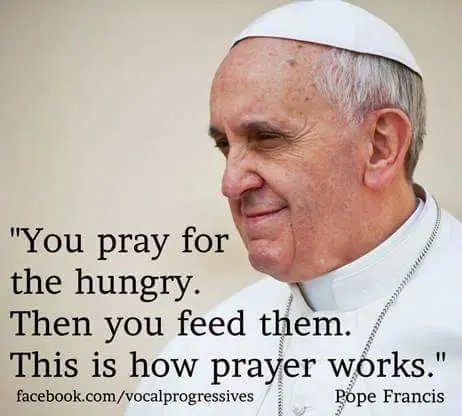 ey need to know their suffering is not the whole story. The sins of my life and those around me do not define me or sum up who I am. I am defined by the life and death of Jesus, as are my actions. When I feed the hungry, I hope my actions – and often, my words – declare a loving, transforming God.
When someone believes that their behaviour leaves them outside the ambit of God’s forgiveness, I offer them first my forgiveness, as a poor echo of God’s intention and then talk about Jesus.
The church has always, correctly, been criticised when our words and actions have no integrity. We can’t sing about a God of justice and fail to seek it in our world. When we care for someone, it is critical that we can give an account of our hope in Jesus – not in hifalutin language, or some memorised lines, but in common sense words about forgiveness, love, healing and hope.
The gospel in one hand and bread in the other …