Resurrection: The Director’s Cut
We are located in the most astonishing moment – one who was dead and buried is now alive. We say these words easily, as if the story is similarly comfortable, but we know better. We have shared the exhaustion of the disciples’ hope, and have watched for the final end of the story, as the
We are located in the most astonishing moment – one who was dead and buried is now alive. We say these words easily, as if the story is similarly comfortable, but we know better. We have shared the exhaustion of the disciples’ hope, and have watched for the final end of the story, as the women come to anoint Jesus’ body. The risen sun greets them, accompanied by a young man, with an impossible story. (“Do not be alarmed…!”)
And everything begins.
Mark tells us the story as simply as he has so many others; eight verses suffice to encompass grief, duty, wonder and fear. Our last verse leaves us where we can understand: frightened and amazed disciples running away, telling nothing to anyone. 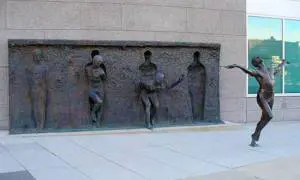 We know their minds were changed, because we have the story now, in our hands.
Someone, of course, thought we required a neater conclusion, and added stories from the early Church to smooth the path of faith – the risen Jesus’ appearances to scatterings of disciples, with a miraculous charge. Walt Disney and Enid Blyton were not the first to like their endings tied in a neat bow; the early church’s historians perhaps felt that Mark’s Gospel left us in an awkward place, so attempted some cutting and pasting to help us forward.
Why should the ragged edges of Friday and the vacuum of Saturday be resolved any more neatly when all creation is renewed on Sunday? Transformation of that size is not easily contained, despite the church’s best efforts. Resurrection is not tidy, is not easily received, is not simply understood. The upheaval of the rolled-away stone signals the upheaval for all those whom God loves. How do we apprehend such a moment?
A litany of the Church states: Christ has died. Christ is risen. Christ will come again. If we recite it smoothly, the words slide right past us, but we believe that God has died and been raised to save the world and in doing so has transformed everything.
We stand two millennia distant from that moment and yet believe that moment is now. Christ is risen; the hope of these words is pregnant with life for everyone. This is not only a story of individuals saved – perhaps least so.
It is the covenant that death is not the last word, God’s life and love are.
In resurrection we declare that the vast injustice of fifty million refugees is not the last word spoken, but that in this life, or in its completion, God will bring justice.
In the risen Christ we name our hope that war is never an answer, but that God’s shalom addresses every question.
In the risen, crucified Christ we state aloud that illness and suffering, that abuse and violence can be confronted and overcome, by healing, justice, forgiveness, reconciliation and perhaps, in “the final consummation of all things which he will bring.”
We are citizens of the reign of Jesus, crucified and risen. Alleluia!